Projects

CAD model of the Cal Aerospace SAE aircraft
Final aircraft assembly — CAD
assets/images/projects/calaero-cad.png

Cal Aerospace SAE aircraft

CalAero · UC Berkeley · 2023–24

Cal Aerospace SAE is a student-run team at UC Berkeley that designs, builds and flies competition aircraft. During my exchange year, I joined the structures team and worked on the development of a 15 ft aircraft, focusing particularly on its landing gear.

My work involved structural analysis and CAD modelling using Ansys and SolidWorks, investigating how the landing gear could withstand heavy landing loads. Working with the team, we refined the design and achieved an approximately 30% improvement in performance. The aircraft subsequently placed third at SAE Aero Design West in April 2025.
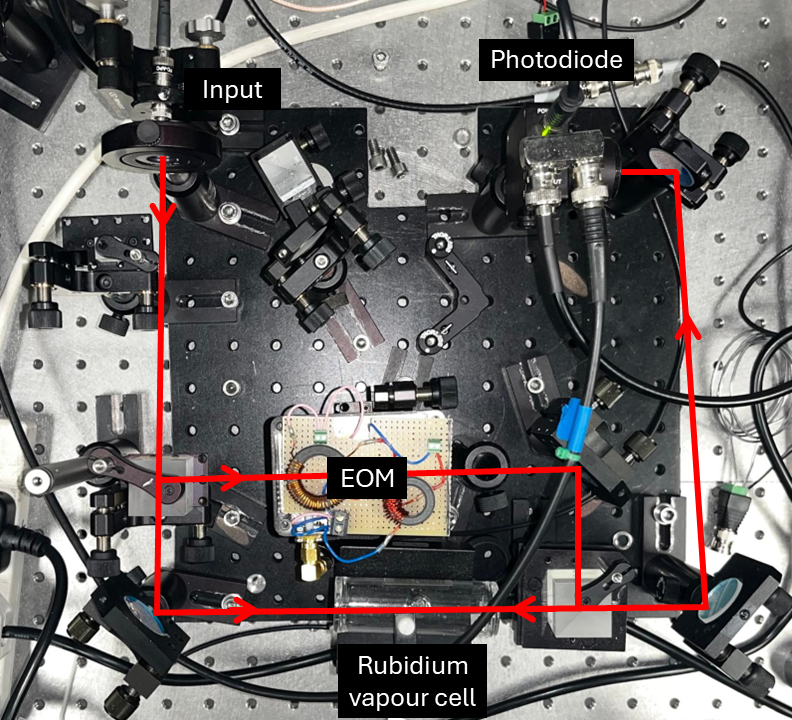
Rubidium saturated-absorption spectroscopy setup
Spectroscopy setup
mot-setup.png
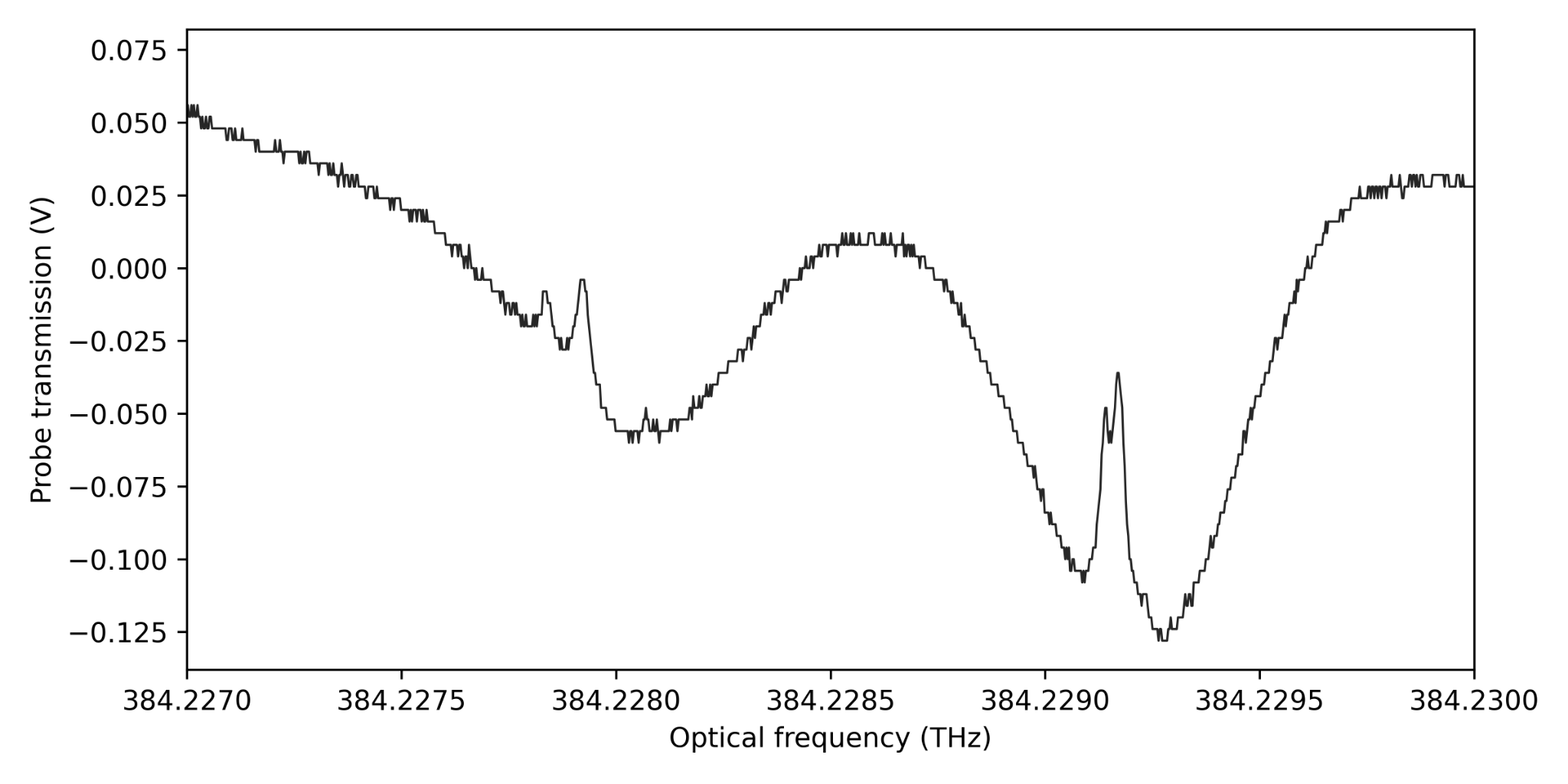
Measured saturated-absorption spectrum of the rubidium D2 line
Rubidium D2 spectrum
mot-spectrum.png

Saturated-absorption spectroscopy of rubidium

Centre for Cold Matter · Imperial College London · July 2026

I worked with a 780 nm pump–probe spectroscopy system used to stabilise a diode laser for a rubidium magneto-optical trap. Saturated-absorption spectroscopy uses counterpropagating laser beams to resolve narrow Doppler-free resonances within the broader absorption profile of room-temperature rubidium vapour.

I aligned the free-space optics, recorded the D2 spectra of 85Rb and 87Rb, and investigated laser-frequency drift. A selected resonance was used with modulation transfer spectroscopy to generate a dispersive error signal for stabilising the cooling laser.

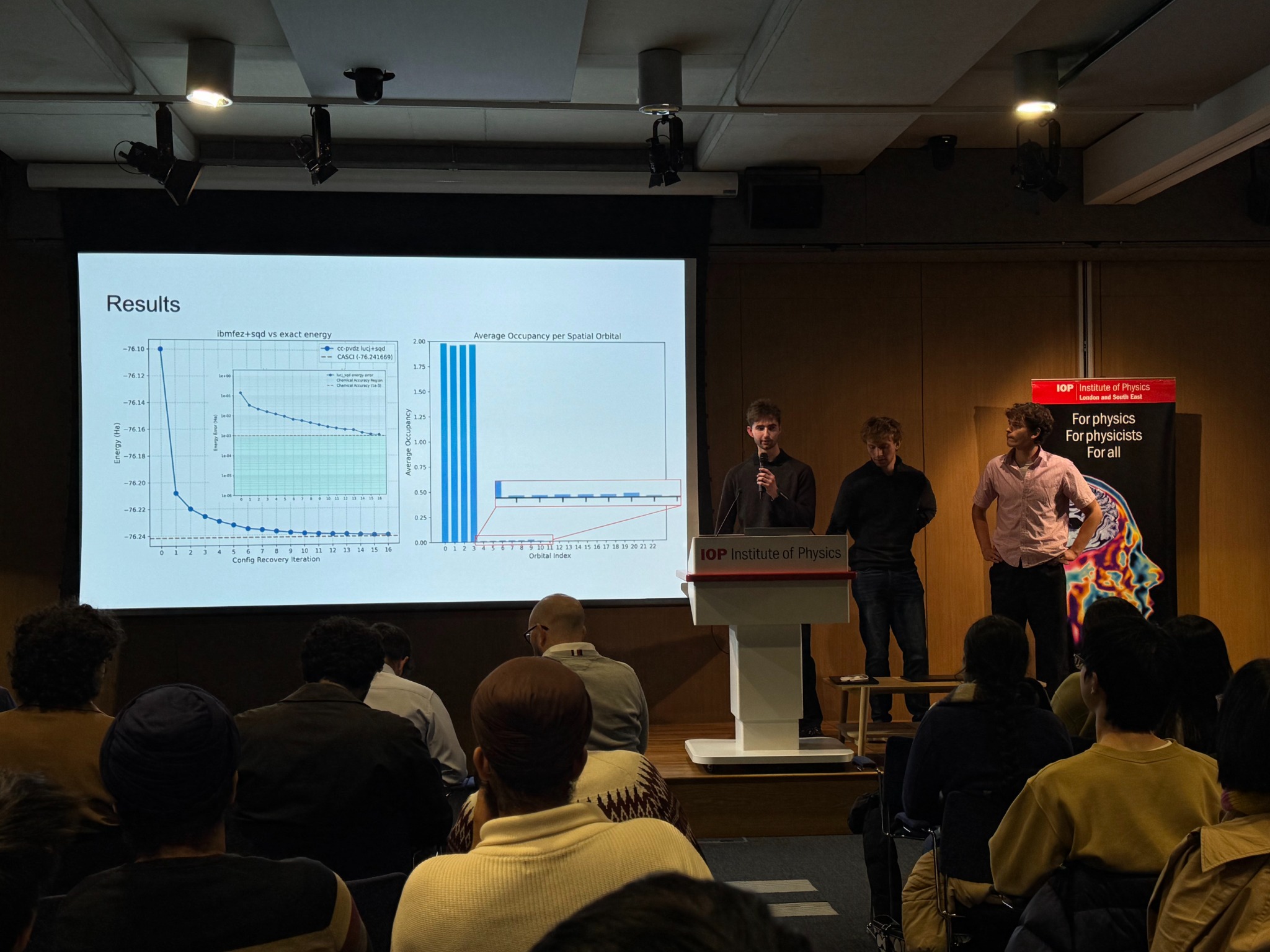
Jude Russell presenting the sample-based quantum diagonalization project
IOP project presentation
assets/images/projects/sqd-presentation.jpg

Ground-state energy estimation with SQD

IBM Qiskit Fall Fest · October 2025

As part of a team project, we applied sample-based quantum diagonalization (SQD) to estimate the electronic ground-state energy of a water molecule. SQD is a hybrid quantum–classical algorithm that uses samples from a quantum circuit to construct a reduced subspace in which the molecular Hamiltonian is diagonalized classically.

We compared the resulting energy estimates with a classical reference and obtained an error below 10−3 Hartree after 18 iterations. We subsequently presented the project at an Institute of Physics event.

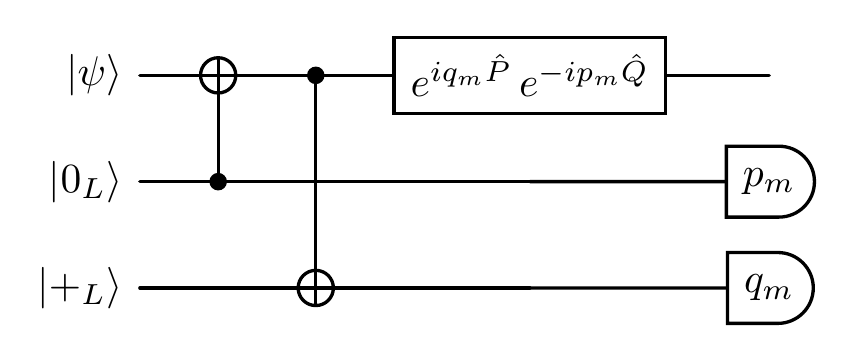
Circuit for a GKP quantum error-correction protocol
GKP error-correction circuit
assets/images/projects/gkp-circuit.png

Surface–GKP quantum error correction

Literature review · March 2026

I reviewed the concatenation of Gottesman–Kitaev–Preskill (GKP) codes with surface codes as a possible approach to fault-tolerant quantum computing. GKP codes encode quantum information in the continuous variables of an oscillator, allowing small displacement errors to be corrected at the physical level.

Combining GKP and surface codes provides an additional layer of protection against errors that remain after GKP correction. My review covered syndrome extraction, decoding and the effects of finite squeezing, as well as possible implementations in trapped-ion, superconducting and photonic systems.

Jude Russell — Surface–GKP QEC