Multimode Brillouin Scattering in Optical Fibre
This page provides a general overview of my MSc research in Brillouin scattering. The precise scope, methodology and findings of the project are not described here for confidentiality reasons.
The spectrum
Stimulated Brillouin scattering arises from the interaction of light with acoustic waves in an optical fibre. Although it is often described by a single resonance near 11 GHz, several closely spaced resonances can arise from different acoustic modes supported by the fibre.
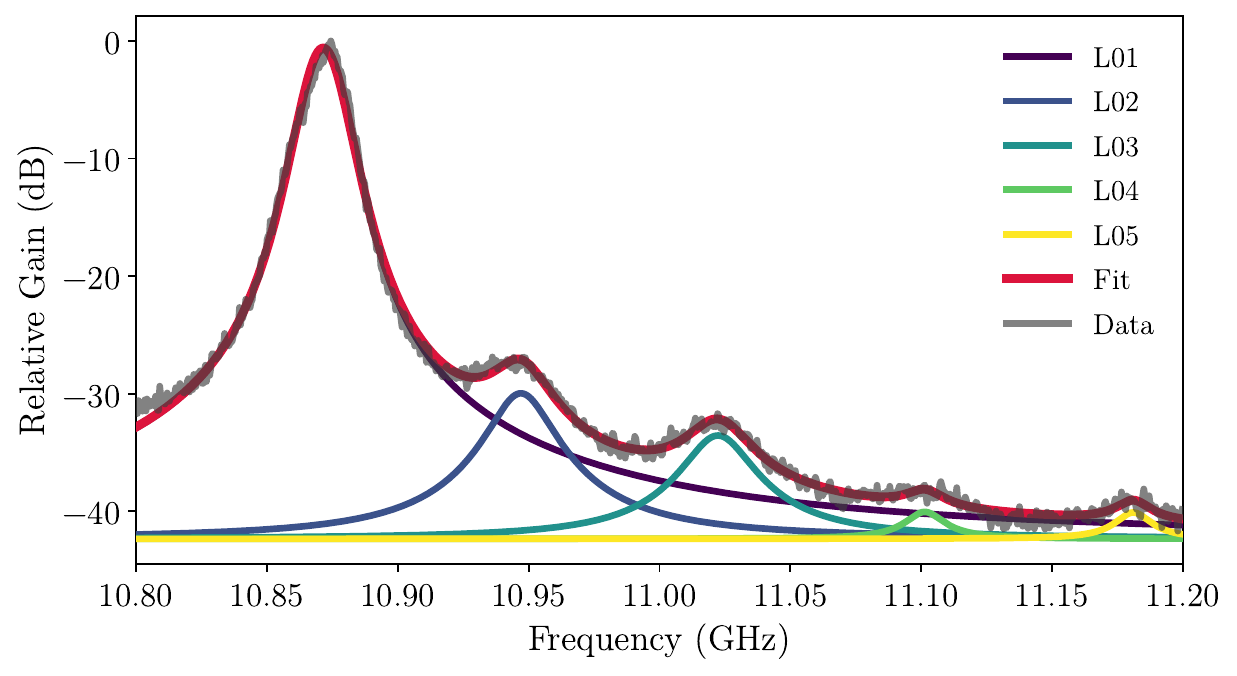
My project investigated multimode Brillouin scattering in standard SMF-28 optical fibre. I measured a spectrum containing five neighbouring peaks separated by approximately 76–82 MHz. These measurements provided a basis for investigating the acoustic modes supported by the fibre.
assets/images/brillouin/spectrum.png
Experiment
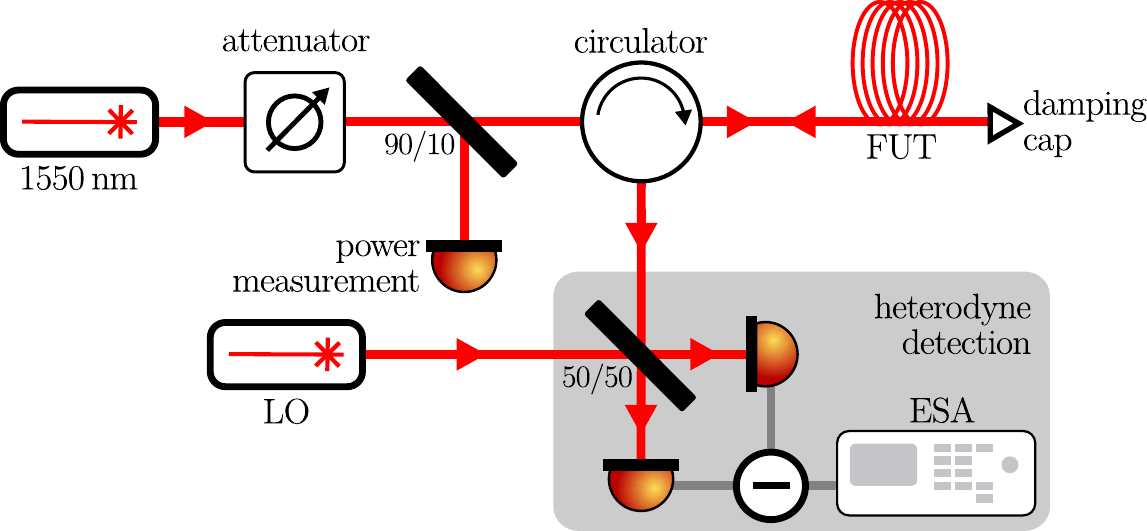
A narrow-linewidth pump was sent through about 10 km of fibre. The backscattered light was mixed with a local oscillator and measured on a spectrum analyser, allowing several overlapping frequency windows to be combined into one spectrum. I fitted the peaks with Lorentzian lineshapes to characterise the resonances and their relative spacing.
assets/images/brillouin/setup.png
Modelling the acoustic modes
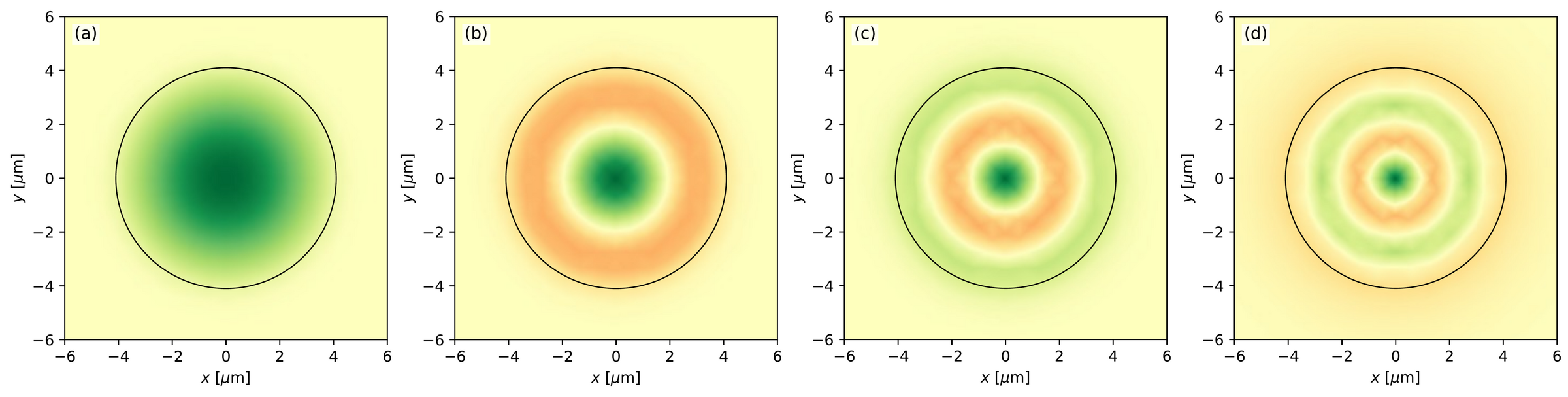
To understand the measured spectrum, I developed a simplified model of acoustic confinement in the fibre. The germania-doped core has a lower acoustic velocity than the surrounding silica, allowing it to guide several acoustic modes with different radial profiles.
Modelling the core with a gradually varying acoustic velocity produces an approximately equally spaced sequence of resonances, consistent with the measured spectrum. The model relates their spacing to the acoustic properties and effective guiding radius of the fibre.
assets/images/brillouin/modes.png
This work was supervised by Dr Michael Vanner in the Quantum Measurement Lab. James Rose contributed to the numerical modelling through discussions and support with NumBAT.