Quantum tunnelling without a barrier: exploring phase-sensitive signatures in HHG
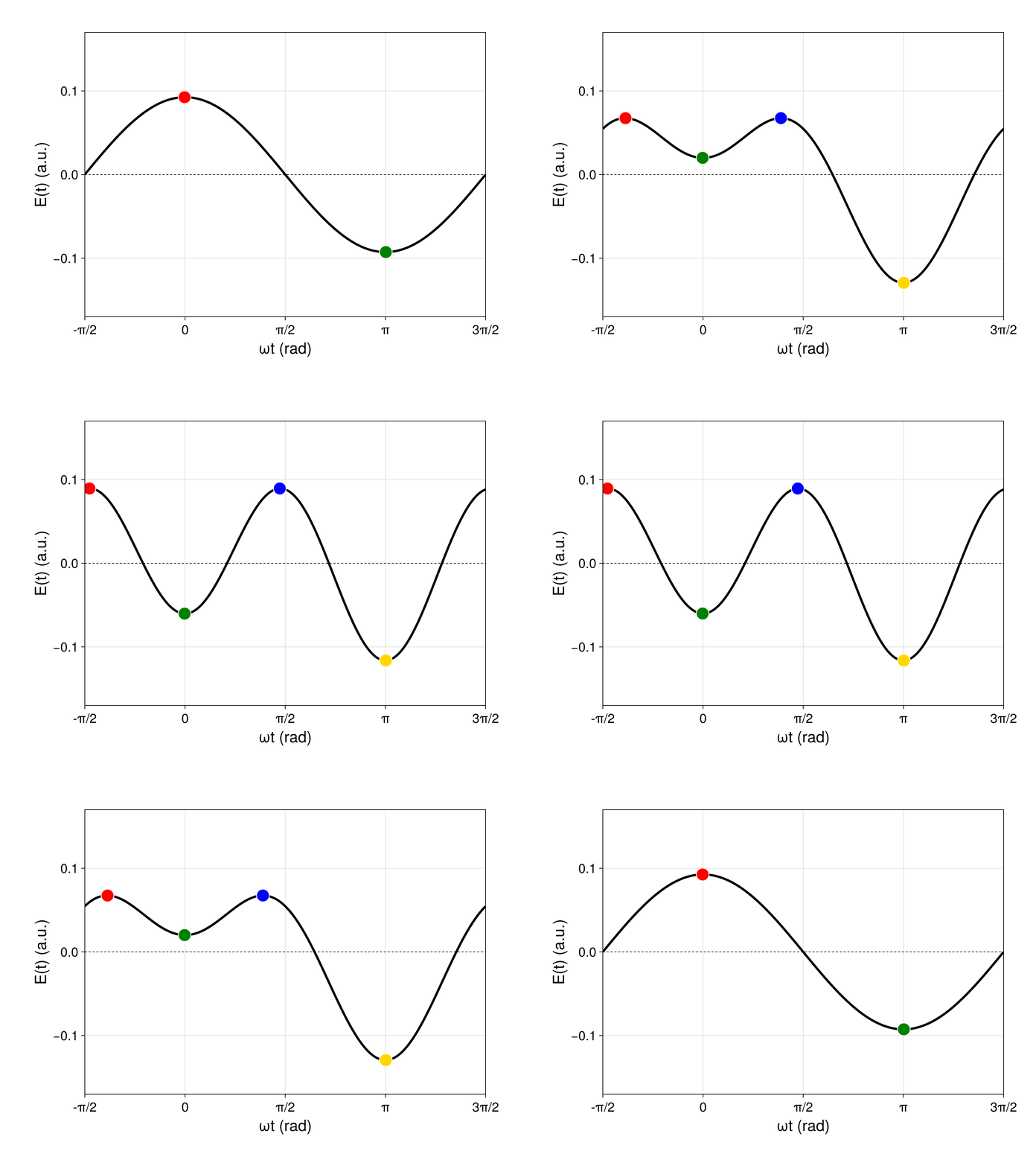
Two-colour fields
High-harmonic generation occurs when an intense laser field releases an electron, accelerates it and drives it back to its parent ion, producing short bursts of high-frequency radiation. The usual semiclassical picture treats the release step as tunnelling through a field-suppressed potential barrier, but the meaning of tunnelling becomes less clear when that barrier disappears.
In this project, I investigated whether the phase of the emitted harmonics could reveal signatures of tunnelling without a barrier. I studied two-colour laser fields combining a fundamental frequency and its second harmonic, varying their relative strengths to explore different ionisation regimes, including configurations where tunnelling can occur at an instant when the electric field vanishes.
Phase-sensitive observables
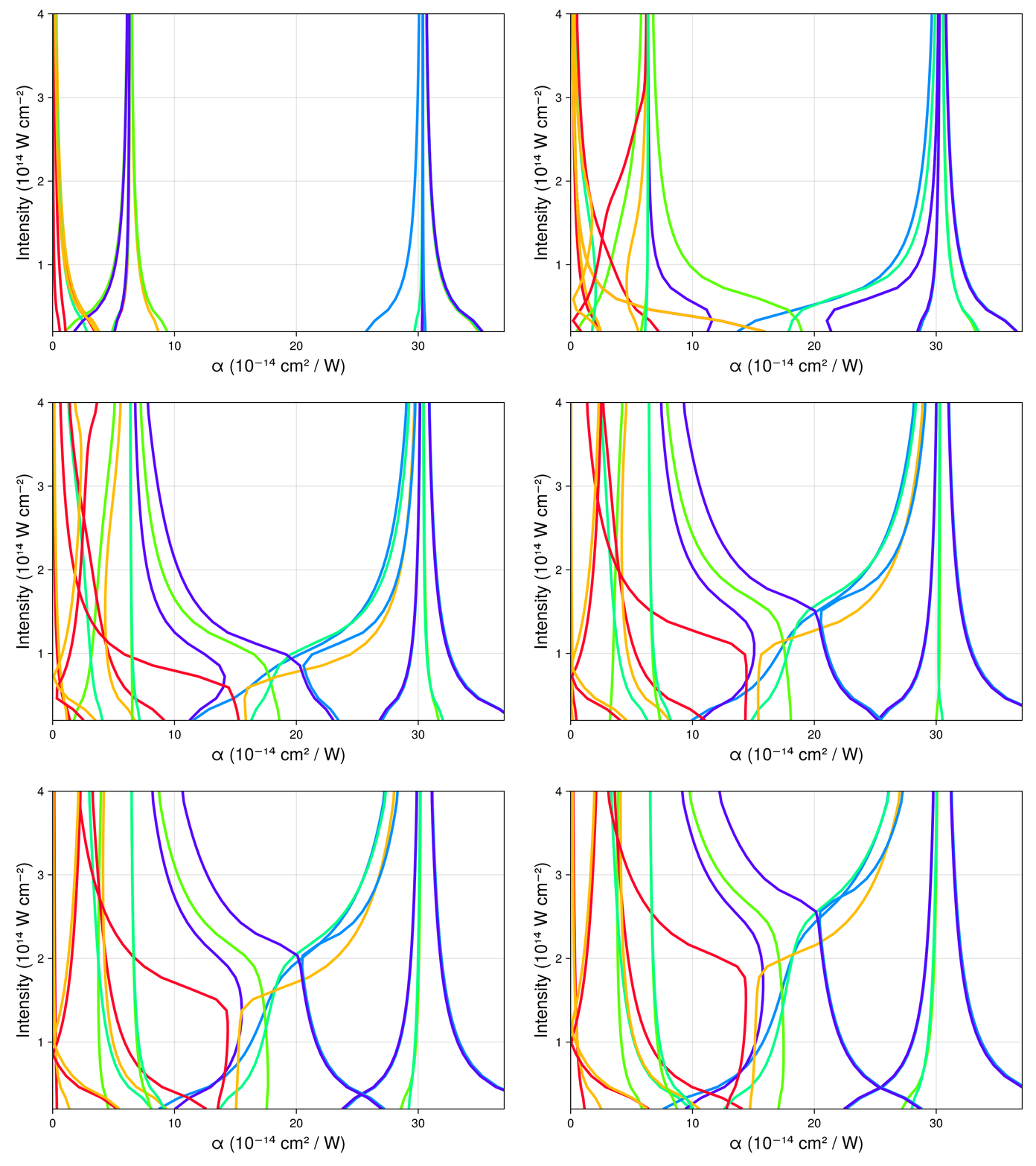
I extended a Julia simulation framework to calculate electron trajectories and quantum-path phase coefficients across a large set of two-colour fields. These coefficients describe how the phase of each harmonic changes with laser intensity.
In two-colour fields, the phase coefficients showed a more complex structure than in the single-colour case, with multiple branches, crossings and cutoffs associated with different electron trajectories. I investigated whether these features could help distinguish tunnelling without a barrier from the other ionisation events contributing to the harmonic spectrum.
Phase-coefficient surfaces
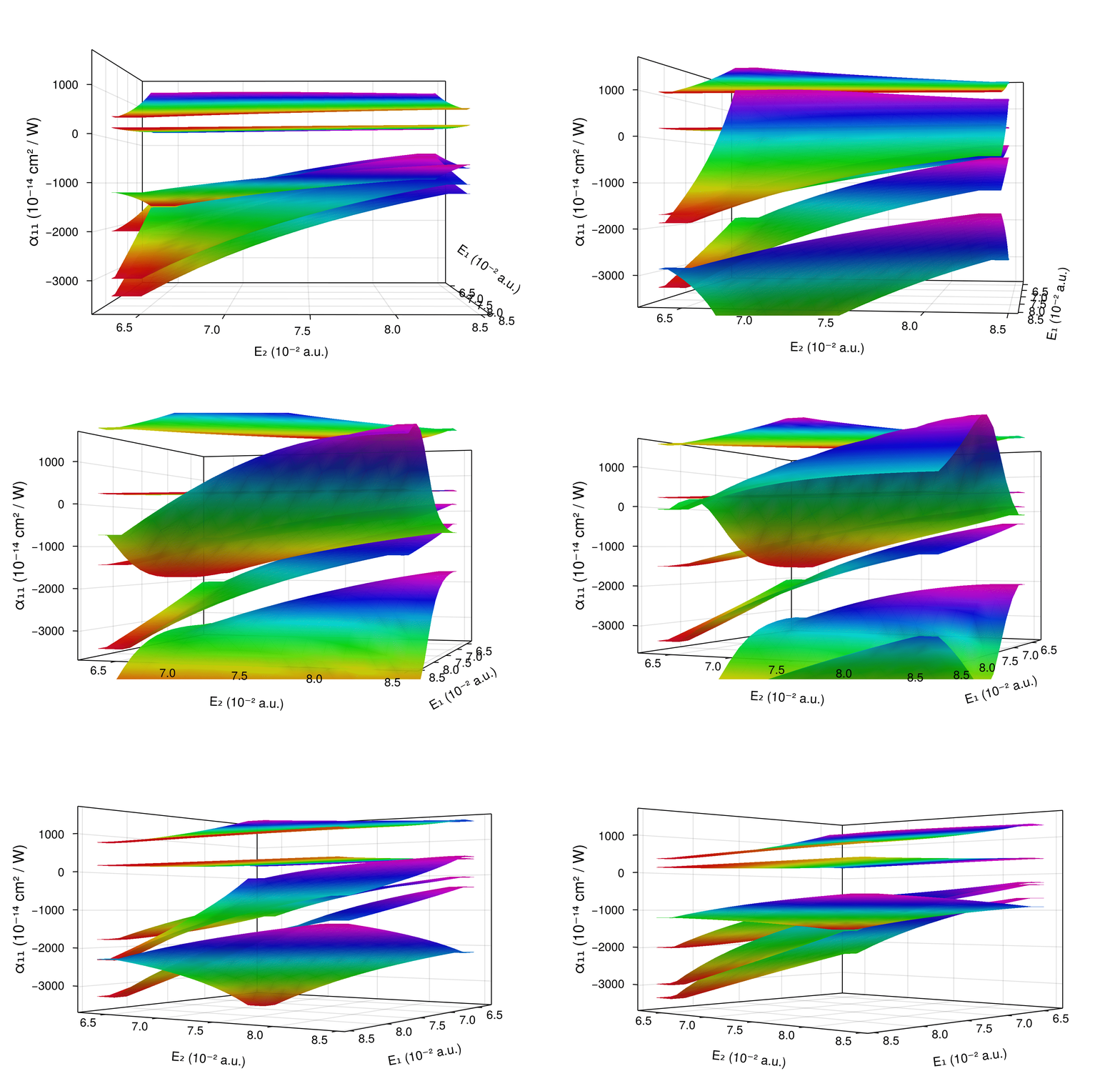
I also calculated phase-coefficient surfaces across a two-dimensional grid of the two laser-field components. The tunnelling-without-a-barrier trajectories showed a particularly strong response in one of the phase coefficients, suggesting a possible way to distinguish this event from the other ionisation processes.
Although no definitive experimental signature emerged, these results identify features that could be explored through phase-sensitive measurements.
The project was supervised by Dr Emilio Pisanty and Dr Anne Weber in Atto@Kings at King’s College London.
Quantum tunnelling without a barrier: phase-sensitive signatures in HHG
A PDF of the thesis is available to download.
Jude Russell — BSc Thesis